Industry Use Cases for Kubernetes
KUBERNETES
Kubernetes is a portable, extensible, open-source platform for managing containerized workloads and services, that facilitates both declarative configuration and automation. It has a large, rapidly growing ecosystem. Kubernetes services, support, and tools are widely available.
The name Kubernetes originates from Greek, meaning helmsman or pilot. Google open-sourced the Kubernetes project in 2014. Kubernetes combines over 15 years of Google's experience running production workloads at scale with best-of-breed ideas and practices from the community.
Going back in time
Let's take a look at why Kubernetes is so useful by going back in time.
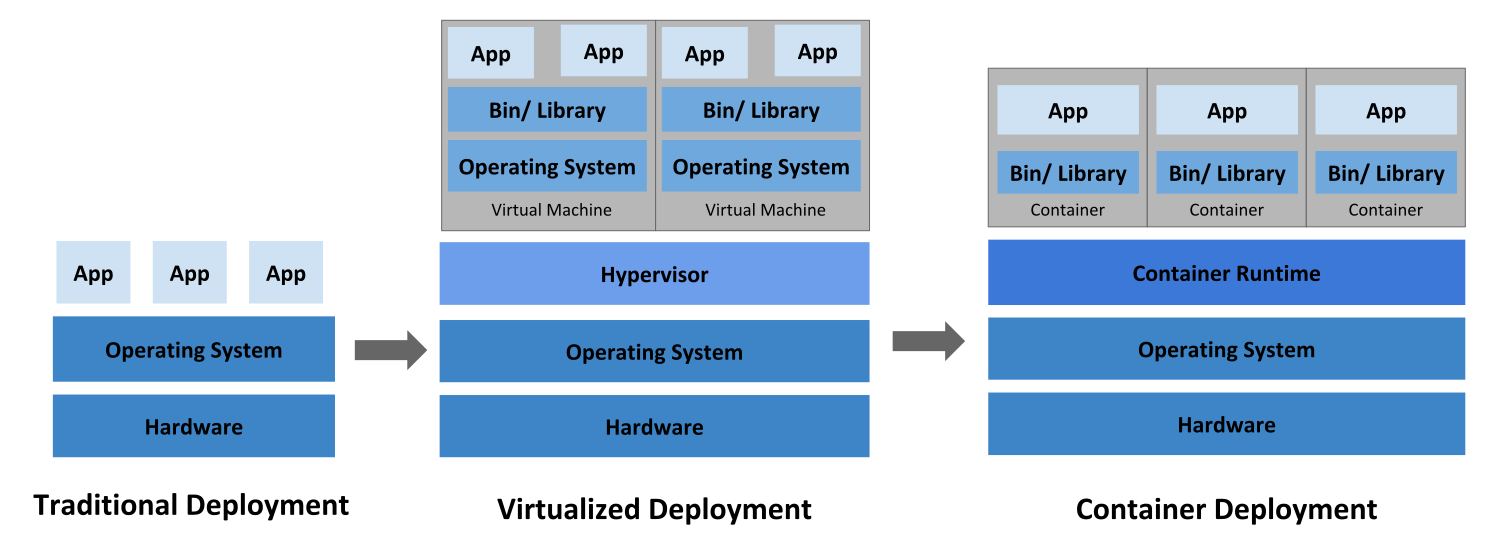
Traditional deployment era: Early on, organizations ran applications on physical servers. There was no way to define resource boundaries for applications in a physical server, and this caused resource allocation issues. For example, if multiple applications run on a physical server, there can be instances where one application would take up most of the resources, and as a result, the other applications would underperform. A solution for this would be to run each application on a different physical server. But this did not scale as resources were underutilized, and it was expensive for organizations to maintain many physical servers.
Virtualized deployment era: As a solution, virtualization was introduced. It allows you to run multiple Virtual Machines (VMs) on a single physical server's CPU. Virtualization allows applications to be isolated between VMs and provides a level of security as the information of one application cannot be freely accessed by another application.
Virtualization allows better utilization of resources in a physical server and allows better scalability because an application can be added or updated easily, reduces hardware costs, and much more. With virtualization you can present a set of physical resources as a cluster of disposable virtual machines.
Each VM is a full machine running all the components, including its own operating system, on top of the virtualized hardware.
Container deployment era: Containers are similar to VMs, but they have relaxed isolation properties to share the Operating System (OS) among the applications. Therefore, containers are considered lightweight. Similar to a VM, a container has its own filesystem, share of CPU, memory, process space, and more. As they are decoupled from the underlying infrastructure, they are portable across clouds and OS distributions.
Containers have become popular because they provide extra benefits, such as:
- Agile application creation and deployment: increased ease and efficiency of container image creation compared to VM image use.
- Continuous development, integration, and deployment: provides for reliable and frequent container image build and deployment with quick and efficient rollbacks (due to image immutability).
- Dev and Ops separation of concerns: create application container images at build/release time rather than deployment time, thereby decoupling applications from infrastructure.
- Observability not only surfaces OS-level information and metrics, but also application health and other signals.
- Environmental consistency across development, testing, and production: Runs the same on a laptop as it does in the cloud.
- Cloud and OS distribution portability: Runs on Ubuntu, RHEL, CoreOS, on-premises, on major public clouds, and anywhere else.
- Application-centric management: Raises the level of abstraction from running an OS on virtual hardware to running an application on an OS using logical resources.
- Loosely coupled, distributed, elastic, liberated micro-services: applications are broken into smaller, independent pieces and can be deployed and managed dynamically – not a monolithic stack running on one big single-purpose machine.
- Resource isolation: predictable application performance.
- Resource utilization: high efficiency and density.
Why you need Kubernetes and what it can do
Containers are a good way to bundle and run your applications. In a production environment, you need to manage the containers that run the applications and ensure that there is no downtime. For example, if a container goes down, another container needs to start. Wouldn't it be easier if this behavior was handled by a system?
That's how Kubernetes comes to the rescue! Kubernetes provides you with a framework to run distributed systems resiliently. It takes care of scaling and failover for your application, provides deployment patterns, and more. For example, Kubernetes can easily manage a canary deployment for your system.
Kubernetes provides you with:
- Service discovery and load balancing Kubernetes can expose a container using the DNS name or using their own IP address. If traffic to a container is high, Kubernetes is able to load balance and distribute the network traffic so that the deployment is stable.
- Storage orchestration Kubernetes allows you to automatically mount a storage system of your choice, such as local storages, public cloud providers, and more.
- Automated rollouts and rollbacks You can describe the desired state for your deployed containers using Kubernetes, and it can change the actual state to the desired state at a controlled rate. For example, you can automate Kubernetes to create new containers for your deployment, remove existing containers and adopt all their resources to the new container.
- Automatic bin packing You provide Kubernetes with a cluster of nodes that it can use to run containerized tasks. You tell Kubernetes how much CPU and memory (RAM) each container needs. Kubernetes can fit containers onto your nodes to make the best use of your resources.
- Self-healing Kubernetes restarts containers that fail, replaces containers, kills containers that don't respond to your user-defined health check, and doesn't advertise them to clients until they are ready to serve.
- Secret and configuration management Kubernetes lets you store and manage sensitive information, such as passwords, OAuth tokens, and SSH keys. You can deploy and update secrets and application configuration without rebuilding your container images, and without exposing secrets in your stack configuration.
What Kubernetes is not
Kubernetes is not a traditional, all-inclusive PaaS (Platform as a Service) system. Since Kubernetes operates at the container level rather than at the hardware level, it provides some generally applicable features common to PaaS offerings, such as deployment, scaling, load balancing, and lets users integrate their logging, monitoring, and alerting solutions. However, Kubernetes is not monolithic, and these default solutions are optional and pluggable. Kubernetes provides the building blocks for building developer platforms, but preserves user choice and flexibility where it is important.
Kubernetes:
- Does not limit the types of applications supported. Kubernetes aims to support an extremely diverse variety of workloads, including stateless, stateful, and data-processing workloads. If an application can run in a container, it should run great on Kubernetes.
- Does not deploy source code and does not build your application. Continuous Integration, Delivery, and Deployment (CI/CD) workflows are determined by organization cultures and preferences as well as technical requirements.
- Does not provide application-level services, such as middleware (for example, message buses), data-processing frameworks (for example, Spark), databases (for example, MySQL), caches, nor cluster storage systems (for example, Ceph) as built-in services. Such components can run on Kubernetes, and/or can be accessed by applications running on Kubernetes through portable mechanisms, such as the Open Service Broker.
- Does not dictate logging, monitoring, or alerting solutions. It provides some integrations as proof of concept, and mechanisms to collect and export metrics.
- Does not provide nor mandate a configuration language/system (for example, Jsonnet). It provides a declarative API that may be targeted by arbitrary forms of declarative specifications.
- Does not provide nor adopt any comprehensive machine configuration, maintenance, management, or self-healing systems.
- Additionally, Kubernetes is not a mere orchestration system. In fact, it eliminates the need for orchestration. The technical definition of orchestration is execution of a defined workflow: first do A, then B, then C. In contrast, Kubernetes comprises a set of independent, composable control processes that continuously drive the current state towards the provided desired state. It shouldn't matter how you get from A to C. Centralized control is also not required. This results in a system that is easier to use and more powerful, robust, resilient, and extensible.
OK, so what specifically can Kubernetes do for us?
Here are five fundamental business capabilities that Kubernetes can drive in the enterprise–be it large or small. And to add teeth to these use cases, we have identified some real world examples to validate the value that enterprises are getting from their Kubernetes deployments
- Faster time to market
- IT cost optimization
- Improved scalability and availability
- Multi-cloud (and hybrid cloud) flexibility
- Effective migration to the cloud.
Kubernetes enables a “microservices” approach to building apps. Now you can break up your development team into smaller teams that focus on a single, smaller microservice. These teams are smaller and more agile because each team has a focused function. APIs between these microservices minimize the amount of cross-team communication required to build and deploy. So, ultimately, you can scale multiple small teams of specialized experts who each help support a fleet of thousands of machines.
Kubernetes also allows your IT teams to manage large applications across many containers more efficiently by handling many of the nitty-gritty details of maintaining container-based apps. For example, Kubernetes handles service discovery, helps containers talk to each other, and arranges access to storage from various providers such as AWS and Microsoft Azure.
Real World Case Study

Airbnb’s transition from a monolithic to a microservices architecture is pretty amazing. They needed to scale continuous delivery horizontally, and the goal was to make continuous delivery available to the company’s 1,000 or so engineers so they could add new services. Airbnb adopted Kubernetes to support over 1,000 engineers concurrently configuring and deploying over 250 critical services to Kubernetes. The net result is that AirBnb can now do over 500 deploys per day on average.

Tinder: One of the best examples of accelerating time to market comes from Tinder. This blog post describes Tinder’s K8 journey well. And here’s the cliff notes version of the story: Due to high traffic volume, Tinder’s engineering team faced challenges of scale and stability. And they realized that the answer to their struggle is Kubernetes. Tinder’s engineering team migrated 200 services and ran a Kubernetes cluster of 1,000 nodes, 15,000 pods, and 48,000 running containers. While the migration process wasn't easy, the Kubernetes solution was critical to ensure smooth business operations going further.
2. IT cost optimization
Kubernetes can help your business cut infrastructure costs quite drastically if you’re operating at massive scale. Kubernetes makes a container-based architecture feasible by packing together apps optimally using your cloud and hardware investments. Before Kubernetes, administrators often over-provisioned their infrastructure to conservatively handle unexpected spikes, or simply because it was difficult and time consuming to manually scale containerized applications. Kubenetes intelligently schedules and tightly packs containers, taking into account the available resources. It also automatically scales your application to meet business needs, thus freeing up human resources to focus on other productive tasks.
There are many examples of customers who have seen dramatic improvements in cost optimization using K8s.
Real World Case Study

Spotify is an early K8s adopter and has significant cost saving values by adopting K8s as described in this note. Leveraging K8s, Spotify has seen 2-3x CPU utilization using the orchestration capabilities of K8s, resulting in better IT spend optimization.

Pinterest is another early K8s customer. Leveraging K8s, the Pinterest IT team reclaimed over 80 percent of capacity during non-peak hours. They now use30 percent less instance-hours per day compared to the static cluster.
3. Improved scalability and availability
The success of today’s applications does not depend only on features, but also on the scalability of the application. After all, if an application cannot scale well, it will be highly non-performant at best scale, and totally unavailable, at the worst case.
As an orchestration system, Kubernetes is a critical management system to “auto-magically” scale and improve app performance. Suppose we have a service which is CPU-intensive and with dynamic user load that changes based on business conditions (for example, an event ticketing app that will see dramatic users and loads prior to the event and low usage at other times). What we need here is a solution that can scale up the app and its infrastructure so that new machines are automatically spawned up as the load increases (more users are buying tickets) and scale it down when the load subsides. Kubernetes offers just that capability by scaling up the application as the CPU usage goes above a defined threshold - for example, 90 percent on the current machine. And when the load reduces, Kubernetes can scale back the application, thus optimizing the infrastructure utilization. The Kubernetes auto-scaling is not limited to just infrastructure metrics; any type of metric--resource utilization metrics - even custom metrics can be used to trigger the scaling process.
Real World Case Study

LendingTree: Here’s a great article from LendingTree. LendingTree has many microservices that make up its business apps. LendingTree uses Kubernetes and its horizontal scaling capability to deploy and run these services, and to ensure that their customers have access to service even during peak load. And to get visibility into these containerized and virtual services and monitor its Kubernetes deployment, LendingTree uses Sumo Logic
4. Multi-cloud flexibility
One of the biggest benefits of Kubernetes and containers is that it helps you realize the promise of hybrid and multi-cloud. Enterprises today are already running multi-cloud environments and will continue to do so in the future. Kubernetes makes it much easier is to run any app on any public cloud service or any combination of public and private clouds. This allows you to put the right workloads on the right cloud and to help you avoid vendor lock-in. And getting the best fit, using the right features, and having the leverage to migrate when it makes sense all help you realize more ROI (short and longer term) from your IT investments.
Need more data to validate the multi-cloud and Kubernetes made-in-heaven story? This finding from the Sumo Logic Continuous Intelligence Report identifies a very interesting upward trend on K8 adoption based on the number of cloud platforms organizations use, with 86 percent of customers on all three using managed or native Kubernetes solutions. Should AWS be worried? Probably not. But, it may be an early sign of a level playing field for Azure and GCP--because apps deployed on K8s can be easily ported across environments (on-premise to cloud or across clouds).

Real World Case Study

Gannett/USA Today is a great example of a customer who is using Kubernetes to operate multi-cloud environments across AWS and Google Cloud platform. At the beginning, Gannett was an AWS shop. Gannett moved to Kubernetes to support their growing scale of customers (they did 160 deployments per day during the 2016 presidential news season!), but as their business and scaling needs changed, Gannett used the fact that they are deployed on Kubernetes in AWS to seamlessly run the apps in GCP.
5. Seamless migration to cloud
Whether you are rehosting (lift and shift of the app), replatforming (make some basic changes to the way it runs), or refactoring (the entire app and the services that support it are modified to better suit the new compartmentalized environment), Kubernetes has you covered.
Since K8s runs consistently across all environments, on-premise and clouds like AWS, Azure and GCP, Kubernetes provides a more seamless and prescriptive path to port your application from on-premise to cloud environments. Rather than deal with all the variations and complexities of the cloud environment, enterprises can follow a more prescribed path:
- Migrate apps to Kubernetes on-premise. Here you are more focused on replatforming your apps to containers and bringing them under Kubernetes orchestration.
- Move to a cloud-based Kubernetes instance. You have many options here-- run Kubernetes natively or choose a managed Kubernetes environment from the cloud vendor.
- Now that the application is in the cloud, you can start to optimize your application to the cloud environment and its services.
Real World Case Study

Shopify started as a data center based application and over the last few years has completely migrated all their application to Google Cloud Platform. Shopify first started running containers (docker); the next natural step was to use K8s as a dynamic container management and orchestration system.

Comments
Post a Comment